
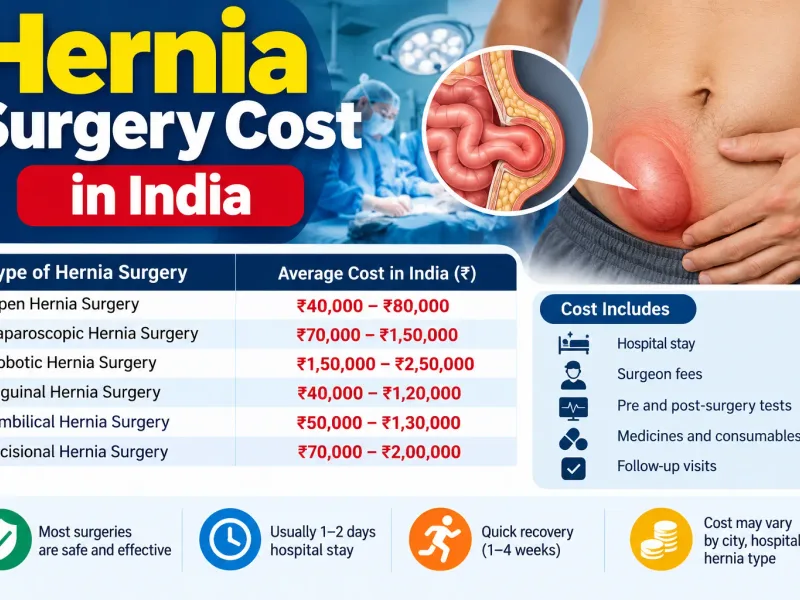
What Hernia Surgery Actually Costs in India
Hernia surgery costs in India range from approximately ₹30,000 for a straightforward open repair at a Tier-2 city government hospital to ₹5.5 lakh or more for robotic-assisted repair at a premium private hospital in a metro city. The national average across all hernia types and cities sits around ₹1,00,000, though that figure masks enormous variation depending on where you get treated and how.
A hernia happens when tissue or an organ — most commonly a section of intestine — pushes through a weakened spot in the surrounding muscle wall. It's one of the most common surgical conditions in India. Inguinal hernias (in the groin) account for roughly 75% of all abdominal wall hernias, with a lifetime risk of approximately 27% in men and 3% in women, according to published data in the International Journal of Surgery (Sonker et al., 2019, IJSURGERY).
Whether you need surgery urgently or are planning an elective repair, understanding costs before you walk into a hospital is not just financially sensible — it changes the conversation you can have with your surgeon.
Cost by Surgery Type: The Biggest Variable
The surgical technique chosen has more impact on your bill than almost anything else, including the city you're in.
Open hernia repair
The oldest technique, still widely performed and appropriate for many patients. A surgeon makes a single incision, repositions the tissue, and reinforces the area — usually with surgical mesh. Cost in India: ₹30,000 to ₹80,000 across most facilities.
Laparoscopic hernia repair:
Keyhole surgery using 3–4 small incisions and a camera. Multiple Indian studies published in IJSURGERY (including Ramaiah Medical College, Bangalore and BGS Global Institute) consistently show laparoscopic repair results in significantly less post-operative pain, shorter hospital stays (mean 3.5 vs. 6 days in one Bengaluru study), and faster return to normal activity — at a higher upfront cost. Cost in India: ₹60,000 to ₹1.2 lakh.
Robotic-assisted hernia repair:
Robotic platforms offer the greatest surgical precision, particularly for complex or recurrent hernias. These are available at select tertiary centres in Delhi, Mumbai, Hyderabad, Chennai, and Bangalore. Cost in India: ₹2.2 lakh to ₹5.5 lakh, according to Ditto Insurance's independently verified 2025 cost analysis.
A 2025 meta-analysis in IJSURGERY covering 8,500+ patients confirmed that laparoscopic repair reduces early post-operative pain significantly (mean difference −1.22 on pain scale, p<0.001) and allows faster return to activity (mean −5.12 days earlier) compared to open repair, with comparable recurrence rates. This evidence base is why laparoscopic repair has become the preferred technique for eligible patients at experienced centres.
City-Wise Cost Breakdown
Location matters — not because surgical skill varies predictably by city, but because hospital real estate, labour costs, and competition among providers all feed into the final bill.
Tier-1 Metro Cities
City | Inguinal Hernia (Range) | Umbilical Hernia (Range) |
Delhi / Delhi NCR | ₹50,000 – ₹2,00,000 | ₹50,000 – ₹2,00,000 |
Mumbai | ₹35,000 – ₹3,40,000 | ₹40,000 – ₹2,50,000 |
Bangalore | ₹35,000 – ₹3,40,000 | ₹40,000 – ₹2,00,000 |
Hyderabad | ₹35,000 – ₹2,90,000 | ₹40,000 – ₹2,00,000 |
Chennai | ₹35,000 – ₹2,70,000 | ₹40,000 – ₹2,00,000 |
Kolkata | ₹35,000 – ₹2,90,000 | ₹40,000 – ₹2,00,000 |
Pune | ₹9,900 – ₹3,00,000 | ₹30,000 – ₹2,00,000 |
Tier-2 Cities
City | Inguinal Hernia (Range) | Notes |
Jaipur | ₹30,000 – ₹1,20,000 | |
Lucknow | ₹30,000 – ₹1,20,000 | |
Chandigarh | ₹30,000 – ₹1,20,000 | |
Ahmedabad | ₹30,000 – ₹1,20,000 | |
Indore | ₹30,000 – ₹1,20,000 | |
Bhopal | ₹30,000 – ₹1,20,000 |
Source: DoctorsApp India (2025), Bajaj Finserv Health platform data, Ditto Insurance verified analysis (2025). Ranges represent minimum to maximum across multiple facility types in each city. Actual costs vary by hospital, surgeon, mesh type, and room category.
The wide ranges within each city are not an error. Delhi's ₹9,900–₹2,00,000 range in the data reflects the difference between a shared-ward open repair at a government hospital and a laparoscopic procedure in a premium private hospital room. Assuming the midpoint applies to your situation without verifying is a common and costly mistake.
What Drives the Price Differences
Hospital tier and accreditation:
NABH-accredited hospitals (National Accreditation Board for Hospitals) typically charge a premium over non-accredited facilities. Corporate chains — Apollo, Medanta, Fortis, Max Healthcare — price at the higher end of their city's range due to infrastructure and staffing costs. Government hospitals price lowest, with the trade-off being longer wait times and, in some facilities, less choice of technique.
Surgeon experience:
A senior laparoscopic surgeon with a large caseload commands higher fees. This is not purely a prestige premium — multiple Indian studies show that complication rates and recurrence risk drop significantly with surgeon experience, particularly in laparoscopic repair, where there's a meaningful learning curve.
Mesh type:
Hernia repair with synthetic mesh has a recurrence rate below 1% in experienced hands, compared to 12–54% for primary suturing without mesh (published data in the Medical Journal of Cell Biology, 2023). Mesh costs vary widely — standard polypropylene mesh is inexpensive; biologic or partially absorbable meshes used in complex cases cost significantly more, and this rarely appears in the headline "surgery cost" figure.
Room category:
Semi-private vs. private vs. deluxe ward adds ₹2,000–₹10,000 per night and is often not included in package quotations. Ask specifically.
Anaesthesia and OT charges:
These are sometimes bundled into package quotes, sometimes not. For a hiatal (diaphragm) hernia — where the stomach pushes into the chest — surgeon fees alone can run ₹50,000–₹1,50,000, with operating theatre charges adding ₹30,000–₹80,000 on top, according to Bombay Hospital's published cost breakdown.
Government Schemes That Can Reduce Your Cost
Ayushman Bharat PM-JAY
India's flagship public health insurance scheme covers hernia surgery for eligible beneficiaries (those in the lower income bracket on the national database). Under the National Health Benefit Package 2022, the reference rate for laparoscopic inguinal hernia repair is ₹20,000 for Tier-3 cities, ₹23,400 for Tier-2, and ₹25,000 for Tier-1 cities. If you qualify, verify empanelled hospitals in your city through the official AB-PMJAY portal.
CGHS (Central Government Health Scheme):
For central government employees and pensioners, the CGHS rate for laparoscopic hernia inguinoplasty is ₹38,500 (excluding tacker and mesh costs) at a NABH hospital in a Tier-1 semi-private ward, and ₹32,725 at a non-NABH facility. These are package reference rates — not maximum reimbursable amounts in all cases.
Private health insurance:
Most private health insurance policies in India cover hernia surgery when medically necessary. Standard policies typically cover 70–90% of surgical costs after deductibles. Critically, most policies impose a waiting period of 2–4 years for pre-existing hernia conditions. If you already have a hernia diagnosis and are buying insurance now, check the waiting period clause carefully.
[REVIEWER: Please add any practical advice about what documentation patients should bring to a CGHS or AB-PMJAY empanelled hospital, or common claim rejection pitfalls you have seen in clinical practice.]
What to Ask Before Booking Surgery
Most patients accept the first cost estimate given without realising how variable the components are. Ask your hospital specifically:
Does the quoted price include:
Surgeon fees, anaesthesia charges, mesh (and which type), OT charges, hospital bed for 2–3 nights, pre-operative tests (blood work, ultrasound, ECG), post-operative medication, and at least one follow-up consultation?
What does it not include?
Many packages exclude the cost of the mesh — which for biologic or absorbable meshes can add ₹20,000–₹80,000 — and post-discharge medication.
Is this surgeon specifically trained in laparoscopic repair?
Laparoscopic hernia repair has a meaningful learning curve. Outcomes improve substantially once a surgeon has completed their initial volume of cases. It's a fair and reasonable question.
What's the recurrence protocol?
A surgeon or centre confident in their technique will have a clear answer. One that deflects this question deserves scrutiny.
FAQ
How much does hernia surgery cost in India on average?
The national average hernia surgery cost in India is approximately ₹1,00,000, ranging from ₹30,000 for open repair at a Tier-2 government or private clinic to ₹5.5 lakh or more for robotic-assisted surgery at a premium metro hospital. The surgical technique — open, laparoscopic, or robotic — is the single largest cost driver, followed by city tier and hospital type.
Is laparoscopic hernia surgery worth the extra cost in India?
For most eligible patients, yes. Multiple Indian studies show laparoscopic repair results in significantly less post-operative pain, hospital stays roughly 2–3 days shorter than open repair, and faster return to daily activity. Recurrence rates are comparable to open mesh repair. The extra cost — typically ₹20,000–₹50,000 more than open repair — is often justified by reduced recovery time, particularly for working-age patients. The final decision should be made with your surgeon based on your specific hernia type and medical history.
Does Ayushman Bharat cover hernia surgery?
Yes. Ayushman Bharat PM-JAY covers hernia repair for eligible beneficiaries. The 2022 National Health Benefit Package sets a reference rate of ₹20,000–₹25,000 for laparoscopic inguinal hernia repair depending on city tier. Patients must be registered under the scheme and treated at an empanelled hospital. The AB-PMJAY beneficiary portal allows you to verify your eligibility and find covered hospitals near you.
Which city in India is cheapest for hernia surgery?
Tier-2 cities including Lucknow, Jaipur, Chandigarh, Ahmedabad, and Indore consistently offer lower minimum and average hernia surgery costs (₹30,000–₹1,20,000 for inguinal hernia) compared to metro cities. However, for complex, recurrent, or large hernias requiring a specialist laparoscopic or robotic approach, travelling to a larger centre may produce better clinical outcomes that outweigh the cost difference.
Can hernia surgery be done without mesh?
Yes, but it's generally not the recommended approach for most adult patients. Primary suture repair without mesh carries a recurrence rate of 12–54% compared to below 1% with mesh repair in experienced hands (published Indian surgical literature). Your surgeon will advise based on your hernia size, location, and tissue quality. Ask specifically about which mesh material is being used and whether its cost is included in your quote.